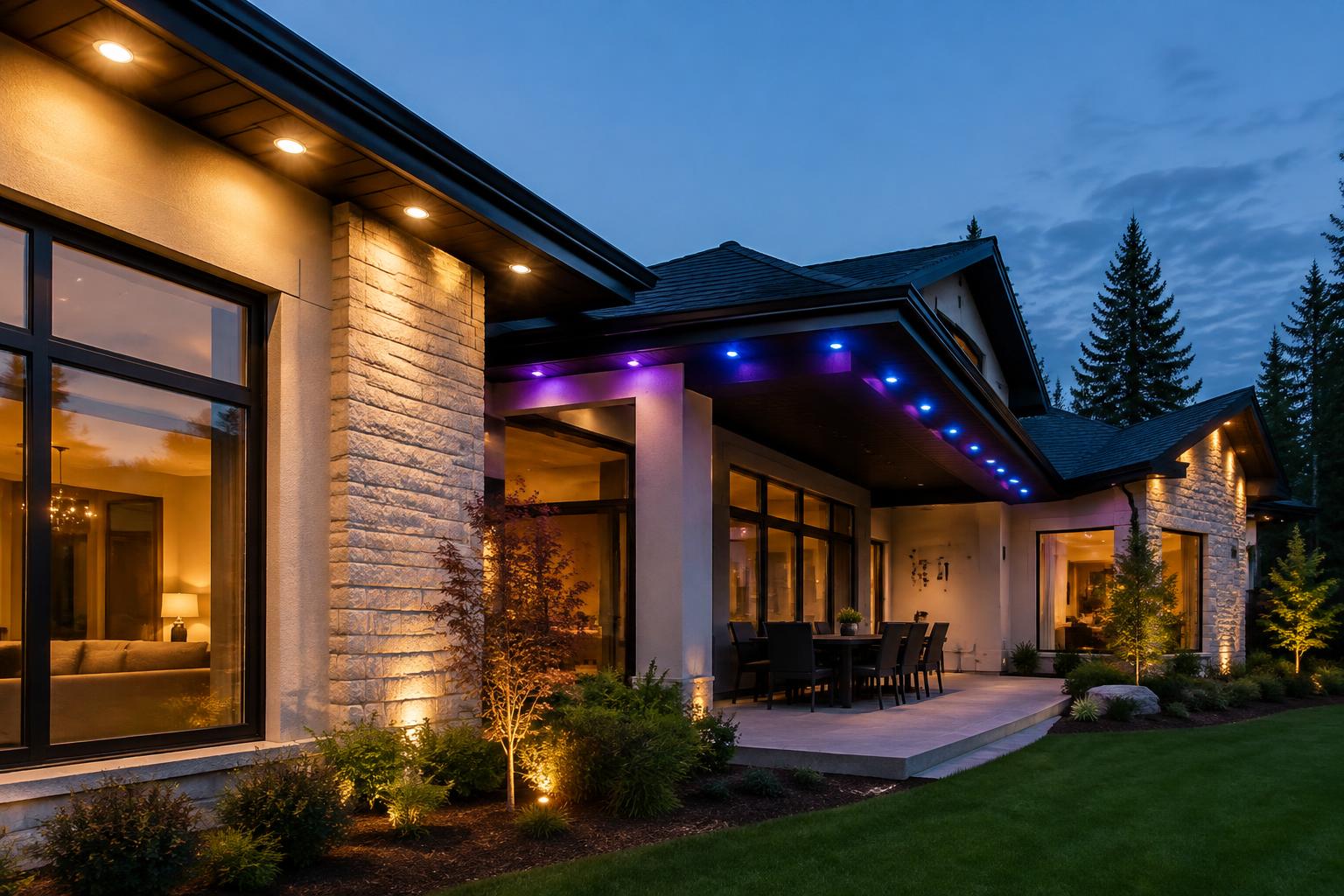
Choose a roofline lighting system you can live with for multiple seasons. Compare climate fit, mounting quality, repair access, app controls, and replacement planning without assuming one brand suits every property.
Compare Permanent Outdoor Lights for Long-Term Use
There is no universal winner among Lumary, Govee, Eufy, Nanoleaf, Philips Hue Festavia, and Enbrighten Eternity. Compare exact models and regional versions, because ratings, controls, permitted layouts, and warranty terms can differ within a brand.
Start with the supported lighting brands, then require model-specific documentation with each proposal. For permanent outdoor lights for long-term use, a recognizable brand name is not a substitute for a serviceable design.
- Lumary: Confirm the proposed kit’s maximum run length, permitted extensions, controller placement, and replacement-part ordering process.
- Govee: Match the exact product generation to its accessories; do not assume controllers, extensions, or light sections interchange across kits.
- Eufy: Ask the installer to demonstrate the proposed model’s schedules and household access, then document its supported wiring layout.
- Nanoleaf: Verify the exact product’s network requirements, supported integrations, and behavior when internet service is unavailable.
- Philips Hue Festavia: Confirm that the specific product permits the intended year-round exposure and mounting arrangement; string-light geometry is not automatically equivalent to roofline-node spacing.
- Enbrighten Eternity: Check permitted extensions, corner routing, mounting accessories, and the procedure for replacing a failed section.
These are verification prompts, not claims that one brand lacks a feature. Consequently, compare written answers rather than treating marketing language as a technical specification.
Match Climate Ratings to Every Component
Weather suitability applies to the whole assembly: lights, connectors, controller, power supply, and supply connection. When evaluating permanent outdoor lights for long-term use, record the operating-temperature range and exposure limits for each component.
Read IP Ratings Correctly
Under the IEC explanation of IP ratings, the first digit addresses solid-object ingress and the second addresses water ingress. IP65 indicates dust-tight construction and protection against water jets; IP67 adds protection under specified temporary-immersion test conditions, not unlimited submersion.
Meanwhile, an IP rating does not establish resistance to salt corrosion, sunlight, ice loads, or every cleaning chemical. Ratings may also depend on correctly seated seals and fully assembled connectors; an open connector does not retain the assembled system’s protection.
Account for Heat, Snow, and Coastal Exposure
Ask how the installation handles hot soffits, wind-driven rain, and snow shedding from the roof. In coastal areas, verify suitable fasteners and compatible metals, because corrosion can undermine an otherwise weather-rated assembly.
Controllers and power supplies need manufacturer-approved placement and ventilation. However, adding an enclosure is not automatically safer: it must accommodate heat, cable entries, and the equipment’s instructions.
Roofline Geometry Determines Installation Quality
Map straight runs, peaks, returns, downspouts, and gaps before ordering. A layout for permanent outdoor lights for long-term use should show both the visible lighting pattern and the concealed route between sections.
Use the roofline lighting visualizer to explore the appearance, then have an installer verify measurements and access on site. A visual concept cannot confirm cable limits, mounting strength, or electrical compliance.
Setbacks, Corners, and Cable Limits
Distance from the wall changes the size and overlap of light patterns. Therefore, request a small nighttime mockup where practical, especially around textured walls, deep soffits, or rooflines with changing heights.
Document approved extension lengths, total system limits, and minimum bend requirements where specified. Never assume a cable can be cut, spliced, or extended simply because another product allows it.
Tracks, Clips, and Fasteners
Tracks can improve alignment and conceal wiring, while individual mounts may better suit certain surfaces or shapes. Either approach must secure the lights without crushing cables, blocking drainage, or preventing replacement.
For permanent outdoor lights for long-term use, specify fastener material, substrate, attachment spacing, and access to track covers. Adhesive-only attachment needs explicit support from the relevant instructions and surface conditions; it should not become an undocumented shortcut.
Explore mounting tracks and installer hardware, including options from affiliated partner Deliciosa Decor. Confirm fit, thermal movement allowances, and installation requirements rather than assuming every channel supports every light.
Repairability Beats a Sealed-In Installation
A failed section should not require dismantling an entire elevation. Compare permanent outdoor lights for long-term use by the smallest manufacturer-serviceable unit, whether that is a node, section, controller, or complete assembly.
In addition, place service connections where an installer can reach them without disturbing roof coverings. Keep junctions out of inaccessible cavities, and avoid routing that traps a replaceable controller behind finished trim.
- Replacement plan: Identify exact part numbers and ask where compatible replacements can be purchased.
- Access plan: Record whether repairs need a ladder, lift, or specialist roof access.
- Spare strategy: Ask which spare components are practical, without assuming stored electronics last indefinitely.
- Handover file: Keep invoices, model numbers, layout photos, circuit details, and setup instructions.
Moreover, ask what happens if that product generation is discontinued. A written migration plan is more useful than an unsupported promise that replacement parts will always exist.
Choose Controls That Match Your App Habits
Daily usability matters when choosing permanent outdoor lights for long-term use. Ask for a demonstration of the actual app and controller, not screenshots from a different model.
Test schedules, brightness adjustment, scene changes, and recovery after a power interruption. Meanwhile, distinguish Bluetooth, Wi-Fi, and any required bridge or hub; each creates different range and setup considerations.
Confirm what works without internet access, whether an account is required, and how another household member gets access. For businesses, assign account ownership to the organization and document staff changes without sharing passwords casually.
Finally, ask whether settings survive controller replacement and how firmware updates are handled. An elaborate scene library has limited value if routine operation frustrates the people using it.
Check Code, Warranty, and Support Boundaries
Low-voltage lighting does not remove electrical-safety obligations. The National Electrical Code, NFPA 70, provides a model framework, but the locally adopted edition, amendments, and authority having jurisdiction determine applicable requirements.
Have the installer identify required GFCI protection, suitable outdoor receptacles and covers, cable routing, and any permits or licensed electrical work. Do not treat an extension cord as a substitute for required permanent wiring.
Check safety certification for the exact equipment and intended use; an IP rating is not an electrical safety listing. In addition, require installation to follow product instructions and confirm that proposed modifications are permitted.
For permanent outdoor lights for long-term use, separate the manufacturer’s product warranty from the installer’s workmanship coverage. Ask who pays for diagnosis, removal, shipping, replacement labor, and lift access, and verify exclusions and claim procedures in writing.
Budget for Ownership Effort, Not Just Purchase Cost
Compare proposals with the same roofline coverage, hardware, electrical scope, and access assumptions. Otherwise, a lower initial quote may simply omit work that another installer included.
Expected upkeep includes visual checks for loose mounts, dirty lenses, damaged cables, and connector seals that need attention under the manufacturer’s guidance. Inspect safely from ground level after severe weather, and arrange professional access when necessary.
Include electricity, service visits, app administration, and eventual component replacement in your decision. However, do not assume a fixed lifespan, maintenance interval, or payback without evidence specific to the equipment and site.
A Homeowner Scorecard for Long-Term Outdoor Lighting
Score each proposal from 0 to 2 in the categories below: 0 means undocumented, 1 means partly resolved, and 2 means clearly documented and suitable. This scorecard compares permanent outdoor lights for long-term use without awarding a universal brand winner.
- Climate: Every component fits expected temperatures and exposure.
- Geometry: The layout respects corners, spacing, and run limits.
- Mounting: Tracks, mounts, fasteners, and substrate are specified.
- Repairability: Serviceable units and access routes are identified.
- Controls: The household can manage schedules and outages.
- Support: Product and workmanship responsibilities are clear.
- Maintenance: Inspection and safe-access needs are understood.
- Ownership effort: Records, service costs, and replacement planning fit your expectations.
Double-weight categories that matter most to your property. However, reject unresolved safety or compatibility issues regardless of the total score.
Pre-Purchase Questions and Your Next Step
- Which exact models and accessories will appear on the invoice?
- Can I see the mounting, wiring, and service-access plan?
- What happens after a section fails or the controller is discontinued?
- Which functions work during an internet outage?
- Who handles warranty claims, and which service charges remain mine?
- What documentation and account access will I receive?
The right permanent outdoor lights for long-term use fit your building and your tolerance for upkeep. Request quotes from professional permanent lighting installers through LightPro Connect, and ask each installer to document the same ownership priorities.