Choose accessible mounting locations, protect electrical connections, and keep cable runs within system limits. Here’s what to ask your installer before the tracks go up.
A power brick dangling beside a garage outlet is a permanent lighting power supply mounting problem worth fixing before the roofline tracks go up. The supply and controller need secure support, suitable weather protection, and access for service. Hiding them behind a gutter usually makes all three harder.
Permanent outdoor lights attach to soffit, fascia, and rooflines with tracks or mounts for year-round, app-driven scenes. However, the neatest installation starts with planning the power location, not hanging the first light.
Plan Permanent Lighting Power Supply Mounting First
Walk the cable route from the outlet to the first light. Mark the controller, connectors, soffit return, and every gable transition. Roof pitch and obstacles can turn a short straight-line distance into a long cable run.
Choose a location reachable without removing lighting tracks or gutter sections. A sheltered garage wall may work well, provided the equipment instructions permit that environment and cable route. Avoid hot attic spaces unless every component is rated for the expected temperature.
In Phoenix, heat can drive the location decision; in Seattle, wind-driven rain deserves extra attention. Meanwhile, coastal properties need hardware suited to salt exposure.
Match the Enclosure to the Equipment
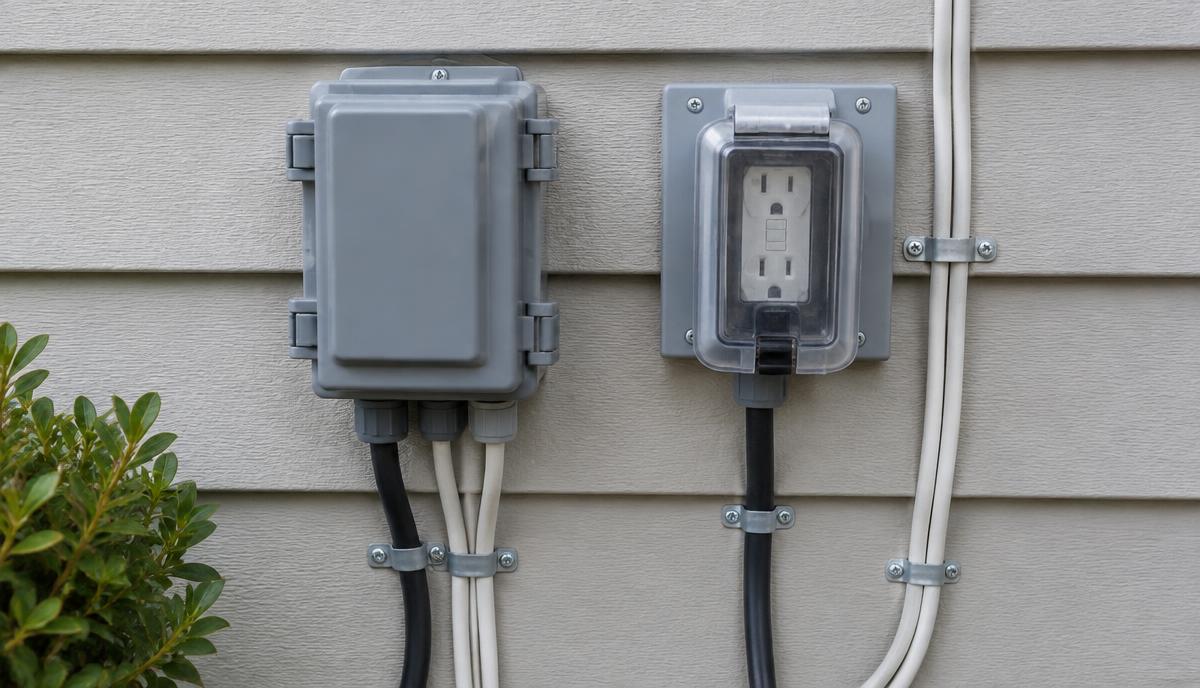
Good permanent lighting power supply mounting protects connections without trapping heat. Follow the manufacturer's required clearances, mounting orientation, and enclosure instructions. Don't assume an outdoor-rated power supply can safely run inside any sealed box.
Read Ratings for Each Component
IP65 describes dust protection and resistance to water jets, not permission for submersion. The supply, controller, connectors, and receptacle may carry different ratings. In addition, an enclosure's protection depends on properly fitted covers, cable glands, and unused-entry plugs.
- Sheltered indoor location: Keeps equipment away from weather, but requires an approved cable route outdoors and may increase run length.
- Outdoor-rated equipment under an eave: Can reduce cable distance, but shelter does not replace the required outdoor rating.
- Suitable outdoor enclosure: Groups equipment neatly, but needs enough room, heat management, and approved cable entries.
For permanent lighting power supply mounting, enclosure material also matters. Metal can weaken wireless signals; plastic may help reception but still needs suitable outdoor and UV ratings. Test app control with the enclosure closed before final fastening.
Mount Without Creating Leaks
Fasten into sound backing, not thin soffit panels alone. If a bracket has 8mm mounting holes or 2.5 inch fastener spacing, check its actual template and specified hardware rather than guessing screw size. Those dimensions are examples, not universal requirements.
Installer tip: inspect above the fastening point before drilling near the drip edge. A screw that catches roofing or flashing can create a leak long before anyone notices the lighting hardware.
Keep GFCI Protection and Disconnects Accessible
Outdoor receptacles generally require GFCI protection under applicable electrical codes. Have a licensed electrician verify the circuit, required weather-resistant receptacle, and cover suitable for use with a plug inserted. A weatherproof equipment box does not automatically satisfy receptacle-cover requirements.
Keep the GFCI test and reset controls accessible. Also identify any upstream GFCI that protects the outlet, because a trip inside the garage can look like a failed outdoor supply.
Don't use extension cords as permanent wiring or bury plug connections inside a wall. Consult the NFPA National Electrical Code resource and local requirements; the CPSC's GFCI safety guidance explains how this protection reduces shock risk.
Control Cable Runs and Voltage Drop
Permanent lighting power supply mounting affects how far low-voltage power must travel. Longer cable, smaller conductors, and heavier loads can increase voltage drop. As a result, distant lights may dim, flicker, or behave unpredictably.
Check Limits Before Adding Extensions
Confirm the permitted low-voltage run length, total light count, extension lengths, and controller capacity for the exact model. Data limits can matter even when voltage looks acceptable. Never assume a larger supply fixes an excessive run.
Use approved extensions and connectors. Add power injection or another supply only if the system specifically supports it; never connect supply outputs together without an approved design. Keep line-voltage and low-voltage wiring separated as required.
- Measure the complete routed distance, including vertical drops and service access.
- Check the manufacturer's cable, load, and extension limits.
- Choose approved cable and outdoor connection methods.
- Test the full layout at its highest permitted load before closing tracks.
- Record each branch length and the equipment feeding it.
Add Service Loops and Useful Labels
Leave a service loop large enough to reach a connector without pulling on its wires. Support it away from sharp edges and respect the cable's bend radius. Separately, form a drip loop below an entry where appropriate so water doesn't follow the cable into equipment.
Installer tip: at a soffit return, leave accessible slack before snapping the last track cover shut. Otherwise, one connector replacement can mean removing an entire corner section.
Don't pinch cable behind J-channel or tighten ties until the jacket dents. Secure cable along the fascia board with compatible supports, leaving gutters and drainage paths clear.
- Power label: Circuit, disconnect location, and upstream GFCI location.
- Equipment label: Supply output, controller model, and installation date.
- Cable label: Destination, such as “front gable,” at both ends.
- Owner record: Wiring photos, manuals, warranty terms, and account-transfer instructions.
Review the Mounting Plan Before Hiring
Ask each bidder to describe permanent lighting power supply mounting, electrical work, and future service access separately. Deliciosa Decor is LightPro Connect's affiliated hardware partner for mounting tracks and channels, not a substitute for model-specific electrical instructions.
LightPro Connect is a nationwide, manufacturer-neutral marketplace connecting homeowners and businesses with vetted installers. They cover Govee, Lumary, Eufy, Nanoleaf, Philips Hue Festavia and Enbrighten Eternity; explore the supported lighting brands before choosing a system.
If you're searching for permanent lighting power supply mounting near me in Dallas or Denver, compare service access as closely as roofline appearance. You can see lighting on your own home and get matched with installers before requesting a detailed scope.
FAQ: Power Supply Mounting and Installation
How Much Does Mounting Cost, and Does It Affect the Warranty?
There isn't a reliable standalone price without the site details. An existing suitable outlet needs less work than a new circuit, enclosure, and difficult cable route. Ask for itemized electrical and mounting costs. Warranty coverage depends on the product terms and installation method, so get written confirmation before anyone modifies cables or equipment.
How Long Can the Cable Run Be, and Will the App Still Work?
The allowed distance depends on the exact system, cable, light count, and approved extensions. Ask your installer to show the published limits for your model. App control also depends on the system's wireless connection. Test scenes with enclosure doors closed and from the owner's phone before signing off on the installation.
Who Should I Hire, and How Long Will Installation Take?
Choose an installer who documents the mounting plan and uses a licensed electrician where required. Timing depends on roof access, electrical upgrades, weather, and equipment availability, so request a site-specific schedule. With LightPro Connect, one request returns multiple local quotes. Compare installation quotes with the enclosure, cable routing, and service plan clearly included.